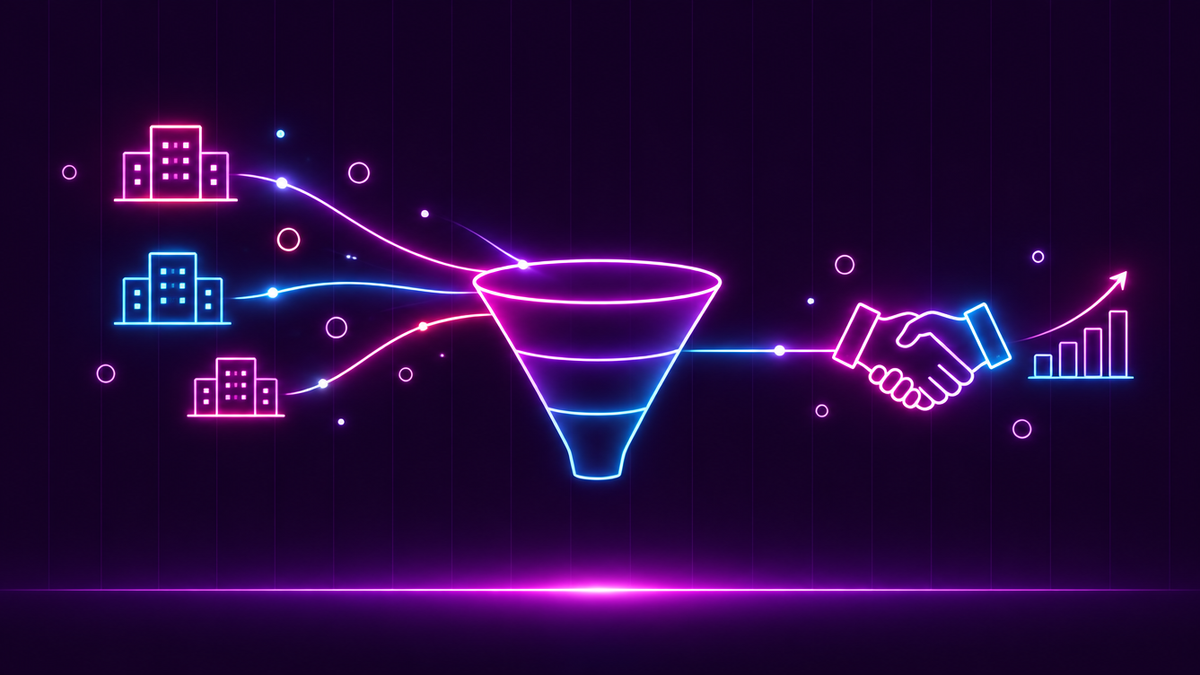
B2B sales is trade between companies. It requires an understanding of the customer's business, long-term relationship building and the ability to use data to find the right customers. Today, successful B2B sales is built on well-reasoned targeting and automation: when you know why a particular company is likely to benefit from what you offer, and automation handles the routine work, the result can be up to 5 times more qualified leads and 87% less time spent on prospecting.
In B2B sales, deal values are typically higher than in consumer sales, purchase decisions are often justified by business benefits, and the seller's role is to act as an expert. The differences are not black and white, though.
How does B2B sales differ from consumer sales?
B2B (business-to-business) means trade between companies, and B2C (business-to-consumer) means trade between a company and a consumer. The difference is not just in the buyer's title, however:
- Purchase decisions are usually justified by business benefits. A company typically invests in a new system only if it makes operations more efficient, saves costs or improves competitiveness. Emotions play a part too – buyers are people, and many entrepreneurs decide partly on gut feel – but your arguments should rest on data and logic.
- The length of the sales cycle varies a lot. Large system purchases can take months of demos and negotiations, while a clear-cut service can be sold in a few days.
- There may be one decision-maker or several. In larger companies, a technical expert, the CFO and the CEO are often all involved in a purchase. In SMEs, the owner makes many purchasing decisions completely independently.
- Deal values are typically higher. A single B2B deal can be worth hundreds or thousands of consumer purchases, which makes every customer relationship valuable.
B2B sales is above all expert work. Your job is not just to sell but to act as a consultant who understands the customer's business challenges and can offer a solution to them.
How is B2B sales done in 2027?
The traditional model, where a seller scrolls through a static company list and calls without any reason, is ineffective. The problem is not reaching out as such, but that the seller has no reason why this particular company would benefit from the offer. Researching the background, finding the decision-maker and tailoring the message by hand, however, takes a lot of time.
Time is the real bottleneck in sales. That is why modern B2B sales is built on data and automation. The process has three phases.
Phase 1: Building a well-reasoned target audience
Everything starts with who you talk to – and why. Industry code and revenue bracket are a good start, but you get the best target audience by looking for information that tells you a company is likely to benefit from exactly what you offer.
Often a single relevant data point is enough. For example:
- Real estate on the balance sheet: If you sell building automation solutions, start with companies whose balance sheet shows they own buildings.
- Email service: If you sell a Microsoft 365 add-on service, start with companies whose DNS record shows they use Microsoft email.
- Certifications and technologies: For example, an ISO 14001 certification or the platform a company's website runs on can tell you who your service suits.
- Changes in the company: New hires, a funding round or a new CEO can give you an extra reason to get in touch – but you don't need to wait for them.
When you can explain why a company is likely to benefit from what you offer, your outreach is not a random interruption but a relevant proposal. In the end, sales is simple: you need a reason – and then you tell it to the customer.
Phase 2: Prospecting and outreach that works
Once the target audience is built, the actual work begins. This is where automation comes in – not as a soulless spam machine, but as an assistant that handles most of the routine work. The best results come from people and machines working together.
Modern sales automation works like this:
- Finds the right companies and decision-makers: The system goes through the market based on the criteria you set.
- Enriches the data: It gathers the essential background information on each company – financials, news, technologies.
- Writes and sends a personal message: The message is sent in the seller's name and in the seller's voice, and it contains data-based arguments that matter to the recipient. AI is used in writing when it improves the result. The message is not "Hi, would you like to buy this?" but, for example, "You have several properties, so automatically optimising their energy consumption could benefit you."
- Handles follow-up and brings in a human: If there is no reply, the system sends a reminder and can create a call task for the seller. The call isn't cold, because you already know who you are calling and why.
This frees the seller's time from manual busywork and gives them a ready reason for every call or meeting.
Phase 3: Delivering value and closing the deal
Once automation has done the groundwork and a prospect replies with interest, the ball passes to the seller. Now begins the part of sales where a person cannot be replaced by a machine.
Your job is to:
- Listen and understand: Dig deeper into the customer's situation and challenges.
- Build trust: Act as an expert partner, not someone pushing a product.
- Negotiate and close: Bring the deal home and make sure both parties are satisfied.
The results measured with our customers speak for themselves: used correctly, automation produces on average 5 times more qualified leads, reduces time spent on prospecting by 87%, and achieves a reply rate of up to 32%. Sales happen every day, even when your calendar is full.
B2B sales salaries and jobs in Finland
B2B sales salaries interest both people looking to enter the field and experienced veterans. It is impossible to give one exact figure, as pay depends on many factors. No official average salary for B2B sellers has been published in Finland for 2026, but data from Statistics Finland provides a good frame of reference.
The closest official occupational class is "Sales representatives" (3322). Although the data is a few years old, it indicates the salary range. In 2019, the average earnings of private-sector sales representatives were about €4,342 per month and the median €4,000 per month. It is important to note, however, that the general level of earnings has risen since then.
Pay almost always consists of several parts:
- Fixed base salary: Secures a basic income and is typically between €2,500 and €4,500 depending on experience and role.
- Commission: A sales-based fee that is often the most significant part of a top seller's income. Commission structures vary greatly between companies.
- Bonuses: Additional rewards for reaching targets (e.g. team or company results).
The salary range is wide. A beginner can earn around €3,000 a month, while an experienced Account Executive selling technically demanding solutions can exceed €10,000 a month with commissions and bonuses. The best-paid sellers are often found in software (SaaS), IT consulting and industrial capital goods.
There are always B2B sales jobs open, as skilled sellers are always in demand. Titles such as Account Manager, Sales Manager, Key Account Manager and Business Development Manager all refer to B2B sales roles.
Frequently asked questions
How do I get started in B2B sales if I have no experience?
Many companies, especially in software and services, actively hire junior sellers for roles such as Sales Development Representative (SDR) or Business Development Representative (BDR). These roles often focus on the early stages of the sales process, such as lead generation and first contacts. It is an excellent way to learn the basics of the field and progress to more demanding sales roles.
What are inbound and outbound sales?
Inbound sales is based on the customer finding you – for example through content marketing, webinars or search engine optimisation – and getting in touch themselves. Outbound sales is proactive: you contact a potential customer who may not yet know your company. Modern B2B sales often combines both strategies effectively.
Do I need a university degree for B2B sales?
Not necessarily. Although a business or technical degree is often an advantage, it is not an absolute requirement. What matters most is the right attitude, the ability to learn, problem-solving skills and a genuine interest in the customer's business. Many of the most successful sellers have learned the profession on the job. Sales experience and proven results often weigh more in recruitment than a diploma.