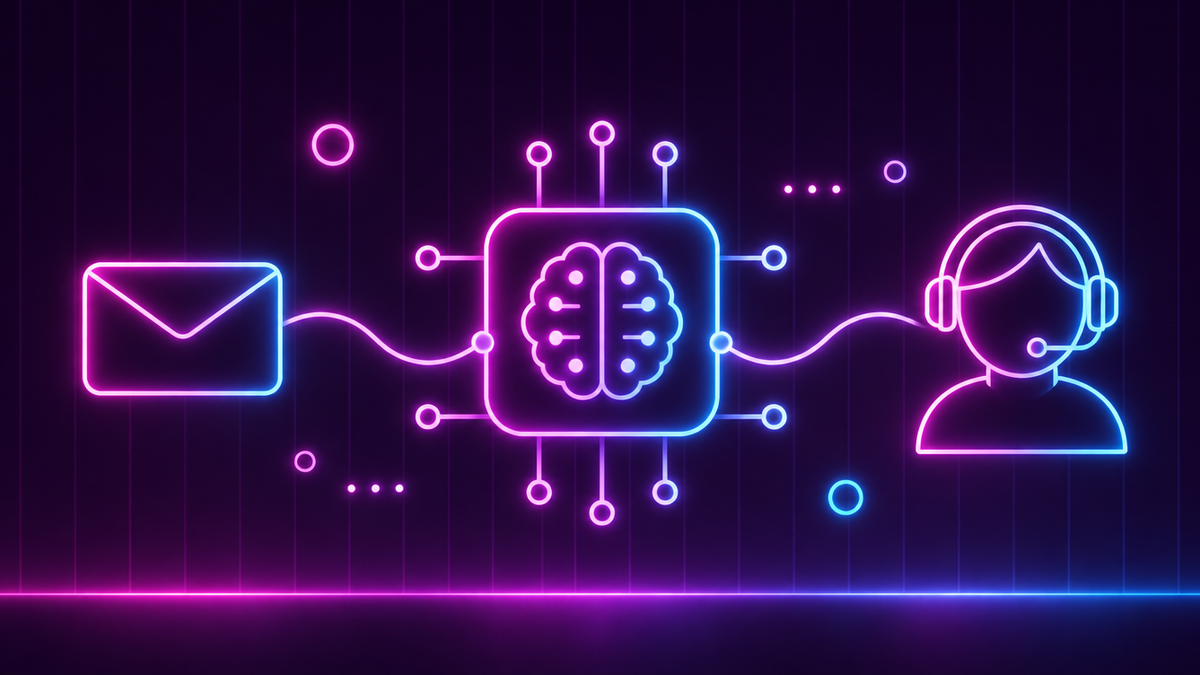
AI in sales is transforming B2B selling by automating the routines of prospecting, background research and outreach. This frees the seller to build trust and close deals. Measured with our customers, the result is up to five times more qualified leads.
An AI sales assistant handles most prospecting routines, such as analysing target companies, identifying decision-makers and writing outreach messages. The best results, however, come from people and machines working together. Every message sent is automatically logged in the CRM.
What is an AI sales assistant and how does it differ from traditional automation?
An AI sales assistant is AI-powered software that independently handles the early-stage tasks of the sales process. It is like your own sales assistant, working tirelessly in the background even when you are in a meeting or on holiday. It ensures a constant flow of new, high-quality opportunities into your pipeline.
The difference from traditional email automation is huge. Where old tools send the same generic message to lists of thousands of people, real sales AI does exactly the opposite. It bases its work on high-quality, up-to-date company data, analyses each target company individually and builds a message that is genuinely relevant to the recipient.
A real AI sales assistant automatically carries out the entire chain:
- Research: It gathers facts about the target company, such as website content, financials and the technologies in use, to find a well-founded reason to get in touch. Sometimes the reason is a recent change, such as a funding round or a new decision-maker, but often an ordinary data point is enough – for example, that the company uses Microsoft email or owns real estate.
- Identifying the decision-maker: Based on predefined criteria, it finds the right person in the company to contact. Unlike many tools, it doesn't rely on LinkedIn alone but also uses official company registers and company websites.
- Writing the message: Based on the data, a message is written that explains why the outreach is relevant to the recipient. AI is used in writing when it improves the result – what matters most is that the message contains the data-based arguments that are relevant to the recipient.
- Sending and follow-up: The message is sent from the seller's own email and in the seller's name. The assistant tracks whether there has been a reply. If not, it sends a friendly reminder and can create a call task for the seller.
- CRM update: Every message sent is automatically logged against the right company and person in the seller's CRM.
The seller steps into the process when a prospect replies with interest. All the heavy lifting before that has already been done.
What is AI good for in sales – and what not?
The power of AI lies in its ability to process huge amounts of data and perform repetitive tasks quickly and accurately. It doesn't replace people, though; it makes their work more effective. It is critical to understand what AI is suited for and where the seller's human input remains irreplaceable.
AI's strengths: The machine's tasks
- Prospecting and lead generation: AI is unbeatable at identifying potential customers in large data sets. It can filter the market precisely by industry, revenue, location, technology use or dozens of other company facts. This saves sellers up to 87% of the time spent on prospecting.
- Data enrichment and analysis: AI can gather and combine information from different sources, such as company registers, websites and news. It doesn't just collect data; it interprets it and turns it into action. A static company list becomes a dynamic view of what is happening in the market.
- Personalised first contact: Based on data, AI can create highly targeted and individual openers. It can refer to a company's recent news, website content or an industry challenge. A well-reasoned message can raise the reply rate to over 30%.
- Automating routine tasks: CRM logging of sent messages, follow-up messages and creating call tasks are examples of tasks automation handles, freeing up the seller's time.
People's strengths: The seller's tasks
- Building trust and relationships: Sales is ultimately interaction between people. Empathy, listening and a genuine understanding of the customer's challenges are qualities a machine cannot replace. AI opens the door, but people build the bridge.
- Complex problem solving and consulting: When a customer's need is complex and calls for a creative solution, an experienced seller's expertise is needed. AI can provide data, but people turn it into strategic advice.
- Negotiating and closing: Closing a deal requires situational awareness, negotiation skills and the ability to handle objections. These are deeply human skills where the seller plays the key role.
- Strategic thinking: The seller is the captain, AI is a powerful ship. The seller sets the course: what the ideal customer profile is, what the best sales arguments are and how the strategy should change as the market changes.
How does AI change B2B sales in practice?
When routines are automated, the seller's role shifts from executor to more strategic expert. This not only makes work more efficient but also improves the quality and meaningfulness of sales work.
1. Sales becomes predictable and systematic
In manual sales, activity fluctuates. When you are busy closing deals, prospecting gets neglected. A dry spell follows when there are no new openings in the pipeline. An AI sales assistant ensures an even, continuous flow of new opportunities. It turns sales into a systematic activity whose results can be measured and forecast far more accurately than before.
2. The seller's time goes to the right things
When a seller doesn't have to spend dozens of hours a month searching for potential customers and typing cold emails, they can focus on warm leads and existing customer relationships. This improves both sales efficiency (hit rate) and customer satisfaction.
Example of the division of work:
- Machine: builds the target audience, finds the decision-makers, writes and sends the messages and handles follow-ups.
- Machine and human together: if there is no reply, automation creates a call task for the seller. The call isn't cold, because the seller already knows who to call and why.
- Human: holds the sales conversations, builds trust and closes the deals.
3. Sales quality and personalisation improve
Paradoxically, automation can make sales more human. When AI handles the data analysis, every outreach can be justified much better than manually. The message is no longer "Hi, I sell product X, are you interested?" but "I noticed you use technology Y and have recently hired a new logistics manager. Our service Z could help you in this situation because..."
This approach respects the recipient's time and shows that the seller has done their homework – or rather, that their assistant has.
How to get started with AI?
Getting started is easier than many think. The key is not to acquire a complex technology arsenal but to start with one clear problem: the bottleneck in your sales.
- Define your ideal customer profile (ICP): Who is your best customer? Which company characteristics indicate that it would likely benefit from what you offer? The more precisely you can define your target audience, the more effectively AI can find it.
- Choose the right tool: There are many kinds of tools on the market. Email automation alone is not an AI sales assistant. Make sure the service you choose, such as Zefram Agent, covers the whole process from data mining and analysis to personalised messaging and follow-up.
- Divide the work wisely: Let automation handle the routines and focus on the conversations and call tasks it generates for you. Track the results and adjust your strategy based on data.
AI in sales is no longer the future; it is the present. Companies that adopt it wisely don't just make their sales more efficient – they build a lasting competitive advantage in a market where speed and relevance decide.
Frequently asked questions
How does an AI sales assistant differ from traditional email automation?
Unlike traditional automation, which sends generic messages, an AI sales assistant bases its work on high-quality company data. It analyses each target company individually and builds a message that is genuinely relevant to the recipient.
Which tasks is AI best suited for in sales?
AI excels at prospecting, lead generation, data enrichment and analysis, and creating personalised first contacts. It also handles routine tasks such as CRM logging of sent messages and follow-up messages.
What should the seller focus on when AI handles the routines?
The seller should focus on building trust and relationships, complex problem solving, consulting, negotiating and closing deals. These are human skills that AI cannot replace.
How does AI make sales more predictable?
An AI sales assistant ensures an even, continuous flow of new opportunities, which turns sales into a systematic activity. This means results can be measured and forecast much more accurately, unlike in manual sales where activity fluctuates.
How do I get started with AI in sales?
Start by defining your ideal customer profile (ICP) precisely. Then choose the right tool, such as Zefram Agent, that covers the whole process from data mining to personalised messaging. Let AI handle the routines and focus on the conversations yourself.